
Compliance Guide
ASME B30.20 and BTH-1 for below-the-hook devices
Two standards decide whether a lifting device is accepted on a North American site: B30.20 for safety, marking and inspection, and BTH-1 for design. Here is what each one covers, and what manufacturers and end users each have to produce.
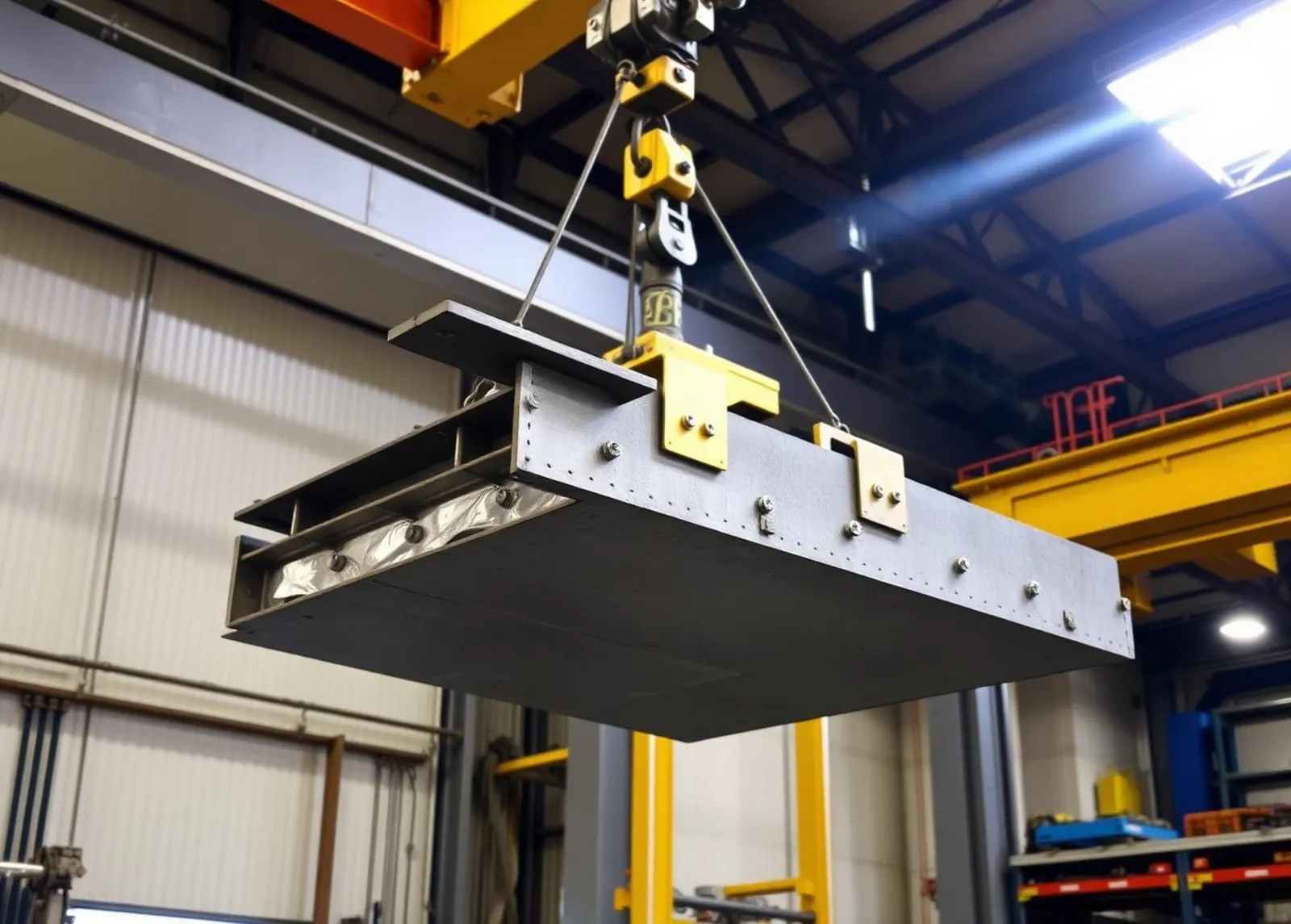
Scope
What each standard actually governs
The two are routinely confused. They are complementary, not alternatives — a device cannot be called compliant on the strength of one alone.
ASME B30.20 — the safety standard
Part of the B30 series. It governs how a below-the-hook lifting device is marked, constructed, installed, inspected, tested, maintained and operated in the field. It applies to structural and mechanical lifters, vacuum lifters, close-proximity operated lifting magnets, remotely operated lifting magnets, and scrap and material-handling grapples.
ASME BTH-1 — the design standard
Referenced by B30.20. It sets the structural, mechanical, electrical and fabrication design criteria the lifter must be engineered to, including allowable stresses, fatigue life and the Design Category and Service Class system.
How they work together
BTH-1 tells the manufacturer how to design the lifter. B30.20 tells the owner and operator how to mark, test, inspect and use it. A compliant device needs both: engineering evidence to BTH-1, and a marking, manual and inspection regime to B30.20.
BTH-1
Design Categories and Service Classes
Every BTH-1 lifter carries a Design Category and a Service Class. Together they set the design factor and the fatigue life the structure is engineered to — and they must be chosen from the real application, not copied from a catalogue sheet.
Design Category
- Design Category A
- Magnitude and variation of loads are predictable, loading and environment are accurately defined and not severe. Design factor of 2:1 on yield.
- Design Category B
- Magnitude and variation of loads are not predictable, or the environment is severe or not accurately defined. Design factor of 3:1 on yield.
Service Class (fatigue life)
- Class 0
- Up to 20,000 load cycles — occasional or one-off duty.
- Class 1
- 20,000 to 100,000 cycles.
- Class 2
- 100,000 to 500,000 cycles.
- Class 3
- 500,000 to 2,000,000 cycles.
- Class 4
- Over 2,000,000 cycles — continuous production duty.
Required marking
B30.20 requires durable marking on the lifter itself. Missing marking is the most common reason a new imported device is rejected on arrival.
- Manufacturer's name and address
- Serial number and model or lifter identification
- Lifter weight (when over 100 lb / 45 kg)
- Rated load
- ASME BTH-1 Design Category
- ASME BTH-1 Service Class
- Cold current amps and rated voltage, for magnets
Owner and operator duties
Compliance does not end at delivery. B30.20 places ongoing obligations on the company using the device.
- Keep the manufacturer's operating, inspection and maintenance manual on file
- Run an operator inspection before each shift
- Run frequent and periodic inspections on intervals matched to service class and duty
- Record periodic inspections in dated, signed reports
- Remove damaged, altered or unmarked lifters from service until re-rated or repaired
- Re-test after structural repairs, alterations or a change in rated load
Canada
What changes for Canadian sites
Manufacturers entering Canada usually meet compliance questions before they meet price questions. These are the four issues that come up most often.
- CSA and provincial occupational health and safety regulations govern use in Canada; several provinces reference the ASME B30 series directly.
- Engineering documentation may need to be reviewed or stamped by a professional engineer licensed in the province of use.
- Imported devices designed to EN or ISO rules usually need a BTH-1 design review, revised marking and English-language manuals before they are accepted on Canadian sites.
- Proof-load test certificates should follow the device from the factory, not be recreated after arrival.
This guide is a plain-language summary for planning purposes. Always work from the current published editions of ASME B30.20 and ASME BTH-1 and the regulations of the province where the device will be used.
Need a device brought into compliance for Canada?
We work with manufacturers on BTH-1 design review, marking, manuals and test documentation so equipment is accepted the first time it reaches site.